
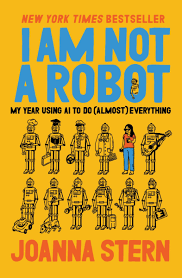
It goes without saying that AI has been dominating the news of late, starting with the apparent non-zero chance that humanity’s extinction may be upon us within a decade. If it’s gonna snuff us out, let’s at least define what “it” even is. According to journalist Joanna Stern, “Artificial Intelligence is the creation of intelligent machines that can think, see, learn, and act like humans, maybe even exceed human abilities.” In her new book, I Am Not a Robot, Stern outlines the hijinks & shenanigans from her solid year experiencing all things AI. Whenever and wherever possible, for 12 long months she and her game family chose high-tech options for their mundane activities, employing machines “trying – sometimes amazingly, sometimes laughably – to mimic how we do things.” As fun a read as this one is, what with its pithy tone, colorful tales, and silly illustrations, it’s jarring as all get-out when one considers the ever-growing power consumption impact of queries born of laziness and/or pure frivolity. Yes, it’s a laugh riot that ChatGPT created that piece of pop art for you one drunken evening, but wait – how much water was used in the process?
“I realized that to embrace the takeover, I’d have to at least become part robot,” writes Stern. This is of course what soulless fucks like Sam Altman want, that we become inseparable from our devices, “like swallowing your phone.” The OpenAI co-founder claims we want technology that is always aware, capable of observing and sensing, at the ready all the time. Do we? The author learned that where toxic social media has pulled us away from each other, as we continue to form a symbiosis with machines, AI could pull us apart from ourselves. The impact on the job market will surely be seismic. She fears for recent grads seeking work, a cohort that for the most part “never learn[ed] how to dig, to listen, to react to the unexpected,” that so-called advancements are hollowing out the pipeline of those who otherwise might have shaped what comes next. Stern manages to keep things light – it’s humorous to picture her pleading with futuristic glasses to help assemble a tent – but the overarching tone of the book is, short of curing cancer someday is any of this really necessary?
We must also bear in mind the side effects. An MIT Media Lab study has revealed some alarming findings regarding users of ChatGPT. Certain participants wrote essays using that tool while two other clusters had either Google or no technological assistance at all. The weakest neural engagement was shown in the first group and only worsened on a second attempt with no AI crutch. “Academics call is cognitive off-loading or even cognitive debt,” writes Stern, adding, “TikTok calls it brain rot.” Ask your doctor indeed! The conclusion drawn is the more we outsource to machines, the less capable we become. Then there’s the ELIZA Effect, so named in the 60’s to describe otherwise quite normal people experiencing powerful delusional thinking after having used a simple computer program. We the reader should be questioning everything. This being Election Day, the timing is perfect as motivated voters march to the polls to weigh in on hot-button topics like data center construction. It seems the vast majority don’t want them in anyone’s backyard, so lest one be a hypocrite they’d stop using the tools.
If you have anything to say about this – or book recommendations – kindly post below (rather than emailing me) to spark conversation. Thank you!