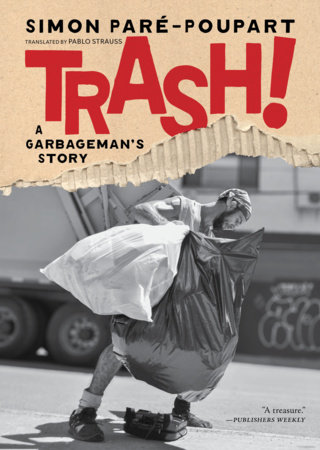
For the past several weeks, I’ve been part of a crew that’s been clearing out a late relative’s rather – ahem – disorganized home (identity of the recently, dearly departed withheld to protect the guilty). Turns out the combination of shopaholic and pack rat can have striking consequences, in this case decades of receipts in disintegrating bags; scattered debris from construction projects and abandoned hobbies; broken furniture piled up awaiting repair; a black & white television and Reagan-era microwave in the far reaches of a baking hot attic for, well, you know – just in case. It’s been the most challenging project I’ve ever been a part of, and that’s saying something having once led the process of prepping my late parents’ two properties for sale. As a companion piece, I read Trash! by Simon Paré-Poupart, a brilliant man from Montreal with multiple grad degrees and a white-collar career who’s also a philosopher of junk. For over 20 years, he’s been a garbageman and the book is his colorful story.
“The garbageman is the Sisyphus of our consumer society,” he writes, “a hapless laborer condemned to go from house to house picking up bags, swept along day after day in the never-ending flow of the refuse we produce.” The reader may push back, noting his obvious intelligence & talents and wonder why return to the route, so many years after such work had funded an education that would afford him the opportunity to walk away and never look back. If he didn’t, “The rats would take over, the air would turn fetid, plague and cholera would run rampant.” In other words, someone’s gotta do it and our hero does it well. He tells his stories poetically, musing that garbage collection may indeed be a vocation, vividly describing the physical challenge, camaraderie, and pride derived from keeping one’s own city streets clean. But the author is also a mercenary in that, by working part-time, he can sell his services to the highest bidder. When a broker is running short staffed and risks losing a lucrative contract, he can sense an opportunity that carries a scent as strong as “the acrid smell of overheated tires and brake pads,” not to mention rotting meat and soiled diapers.
As for all the endless junk and where it ends up, the implications for irreparable environmental damage are obvious and – the author’s humorous anecdotes aside – even this slim, pocket-sized read can feel heavy. What is most welcome is the conclusion centered on something called “freeganism,” a fancy term for the act of repurposing and the rejection of the premises of consumer society. Says Paré-Poupart: “The plain truth is that we already have enough stuff. There’s no need to make more.” In keeping with this, he often finds treasures in the trash and remains on a mission to rescue such. This has helped inspire a movement at the house I described above as it goes on the market. More remarkable than the multiple dumpsters filled has been the countless carloads of goods, many brand new and still tagged, delivered to the not-for-profit thrift shop a few miles down the road. Clothing, decorations, housewares, landscaping equipment, classic toys, on and on, all donated to either be resold or repurposed. The garbageman has seen it all and in this case, is doing his part, encouraging us to go and do likewise.
If you have anything to say about this – or book recommendations – kindly post below (rather than emailing me) to spark conversation. Thank you!